Cloud POS vs. Traditional Cashier System – What’s the Difference?

Many Malaysian business owners are familiar with the traditional cashier system: a standalone machine that handles sales, prints receipts, and stores information on the device itself. It may have worked well for years, but as business needs change, more owners are now comparing it with newer cloud-based POS options.

At the same time, terms like cloud POS, smart POS, and hybrid POS can sound technical or confusing, especially if you are simply trying to find a system that is reliable and practical for your business.

The good news is that the difference is easier to understand once you break it down into day-to-day business needs. For most retailers and F&B operators, the real question is not which type sounds more modern, but which setup gives the right balance of reliability, visibility, and flexibility.

1. What Is a Traditional Cashier System?

A traditional cashier system, sometimes called a legacy POS or electronic cash register, stores its data locally on the machine or on an internal hard drive.

For many businesses, the main advantage is simplicity. These systems are often familiar to staff and can continue working without internet access. That makes them dependable in environments where connectivity is unstable.

However, traditional systems also come with limitations.

Common drawbacks include:
  • sales data may only be accessible from the physical machine
  • owners may not be able to monitor performance remotely
  • backups may depend on manual processes
  • upgrades can be slower or more complicated
  • the system may be harder to adapt as the business grows

This type of setup can still be suitable for some small businesses with simple needs, but it may feel restrictive once reporting, stock control, or multi-outlet visibility becomes more important.

2. What Is a Pure Cloud POS?

A pure cloud POS is a system that runs mainly through the internet, usually via an app, browser, or cloud-connected platform. Data is stored online, and business owners can often access reports, sales, and inventory information from different devices.

This model appeals to many modern businesses because it offers better flexibility and visibility.

Key advantages often include:
  • access to business data from anywhere
  • easier syncing across outlets or devices
  • automatic updates
  • lower dependence on dedicated local servers
  • more convenient reporting and dashboard access

That said, a cloud-only setup also has a trade-off: it depends heavily on internet reliability.

Potential limitations include:
  • slower operations if the connection is weak
  • service interruptions if the internet goes down
  • reduced confidence during peak periods if staff rely fully on connectivity
  • possible delays in syncing or processing during outages

For businesses in areas with strong and stable internet, this may not be a major concern. But for some Malaysian SMEs, internet dependency remains a practical risk that cannot be ignored.

3. What Is a Hybrid POS?

A hybrid POS combines elements of both traditional and cloud systems.

In simple terms, it allows the business to continue operating locally even if internet access is interrupted, while still syncing data to the cloud when the connection becomes available again.

This makes hybrid POS appealing to businesses that want:
  • the reliability of offline operation
  • the convenience of cloud reporting
  • better data backup and visibility
  • less risk of downtime during internet disruptions

For example, a hybrid setup may allow staff to continue processing sales, printing receipts, and running the counter even during a temporary outage. Once the internet is restored, the data can sync back to the cloud.

For many business owners, this model offers a more balanced approach because it does not force them to choose between old-style stability and modern accessibility.

4. How Do These Systems Compare in Real Business Use?

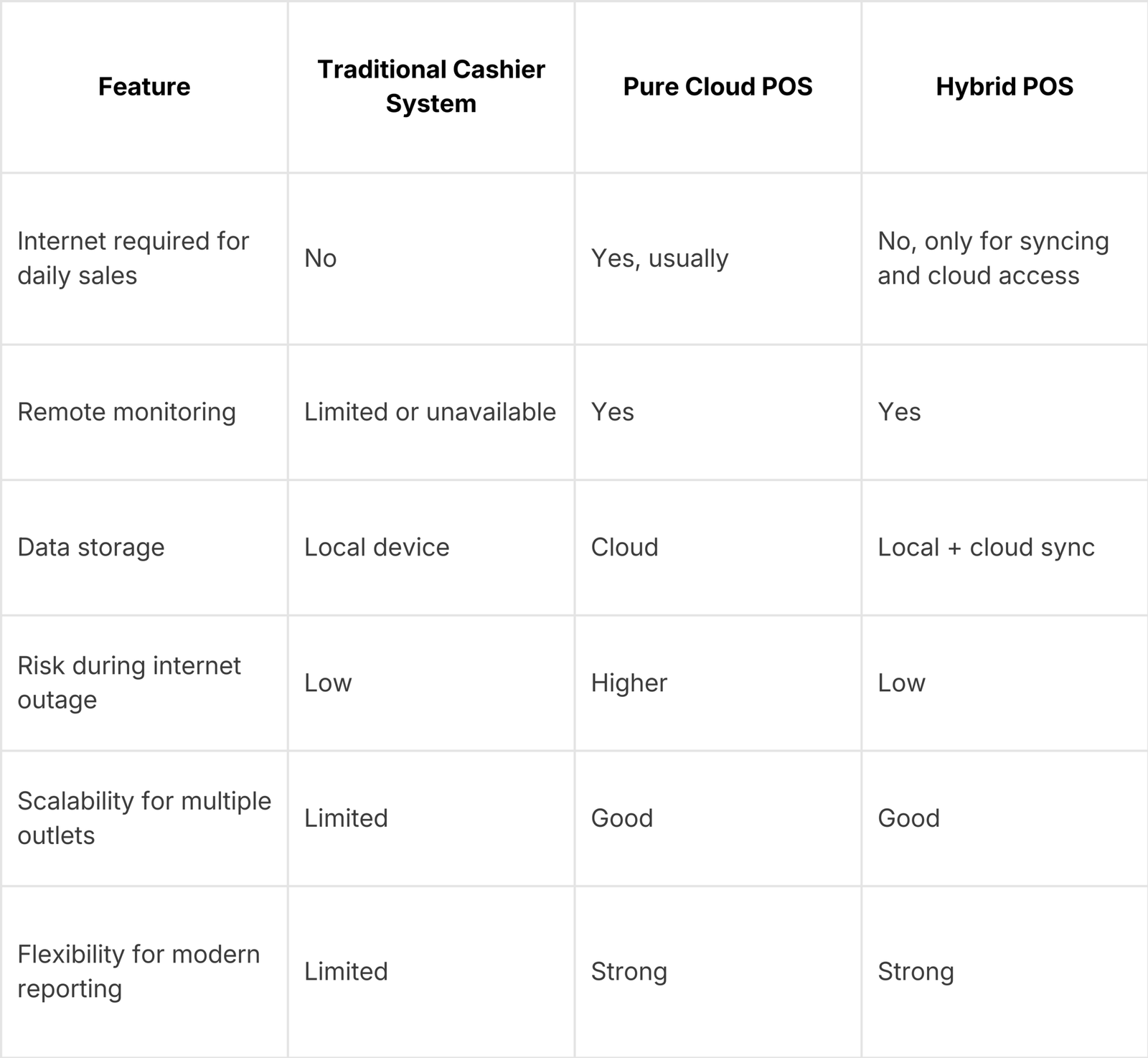
The biggest differences usually come down to a few practical areas: internet dependency, remote access, data protection, scalability, and operational continuity.

Here is a simple comparison:
Feature
Traditional Cashier System
Pure Cloud POS
Hybrid POS
Internet required for daily sales
No
Yes, usually
No, only for syncing and cloud access
Remote monitoring
Limited or unavailable
Yes
Yes
Data storage
Local device
Cloud
Local + cloud sync
Risk during internet outage
Low
Higher
Low
Scalability for multiple outlets
Limited
Good
Good
Flexibility for modern reporting
Limited
Strong
Strong
This is why different businesses may prefer different models. A very small shop with simple needs may still be comfortable with a traditional setup. A fully connected business with stable internet may prefer a cloud-first system. But many SMEs find hybrid especially practical because it supports modern reporting without making the business fully dependent on connectivity.

5. Which Option Is Best for Malaysian SMEs?

There is no single answer for every business. The right choice depends on how the business operates.

A traditional cashier system may still be enough if:
  • you only need basic transaction handling
  • you do not require remote reporting
  • your inventory and operations are simple

A pure cloud POS may suit you if:
  • your internet connection is highly reliable
  • you want remote access from anywhere
  • you run multiple branches and need centralised visibility

A hybrid POS may be worth considering if:
  • you want cloud visibility without losing offline capability
  • your business cannot afford downtime during internet issues
  • you need a balance of flexibility and operational stability
  • you want a system that can support future growth more comfortably

For many Malaysian retailers and F&B operators, that last point is important. The business environment is becoming more digital, but daily operations still need to be practical and resilient.

Conclusion

Choosing between a traditional cashier system, a cloud POS, and a hybrid setup is not only about technology. It is about how well the system supports the way your business actually runs.

Traditional systems can still work for basic needs, while cloud systems offer flexibility and modern visibility. Hybrid systems sit somewhere in between, combining offline reliability with cloud convenience.

For many SMEs, that balance is what makes the biggest difference. Instead of choosing the newest option by default, it is often more useful to choose the one that reduces operational risk and gives you room to grow.

If you are comparing solutions in Malaysia, it may be helpful to look at providers such as Deepsky as part of that evaluation, especially if you are looking for a setup that supports both daily reliability and modern business visibility.
Ready to upgrade your POS system?
Stop juggling spreadsheets, manual sistem pos and separate cashier machines. Move to a smart POS system and cloud point of sale that brings everything together.

In this article